
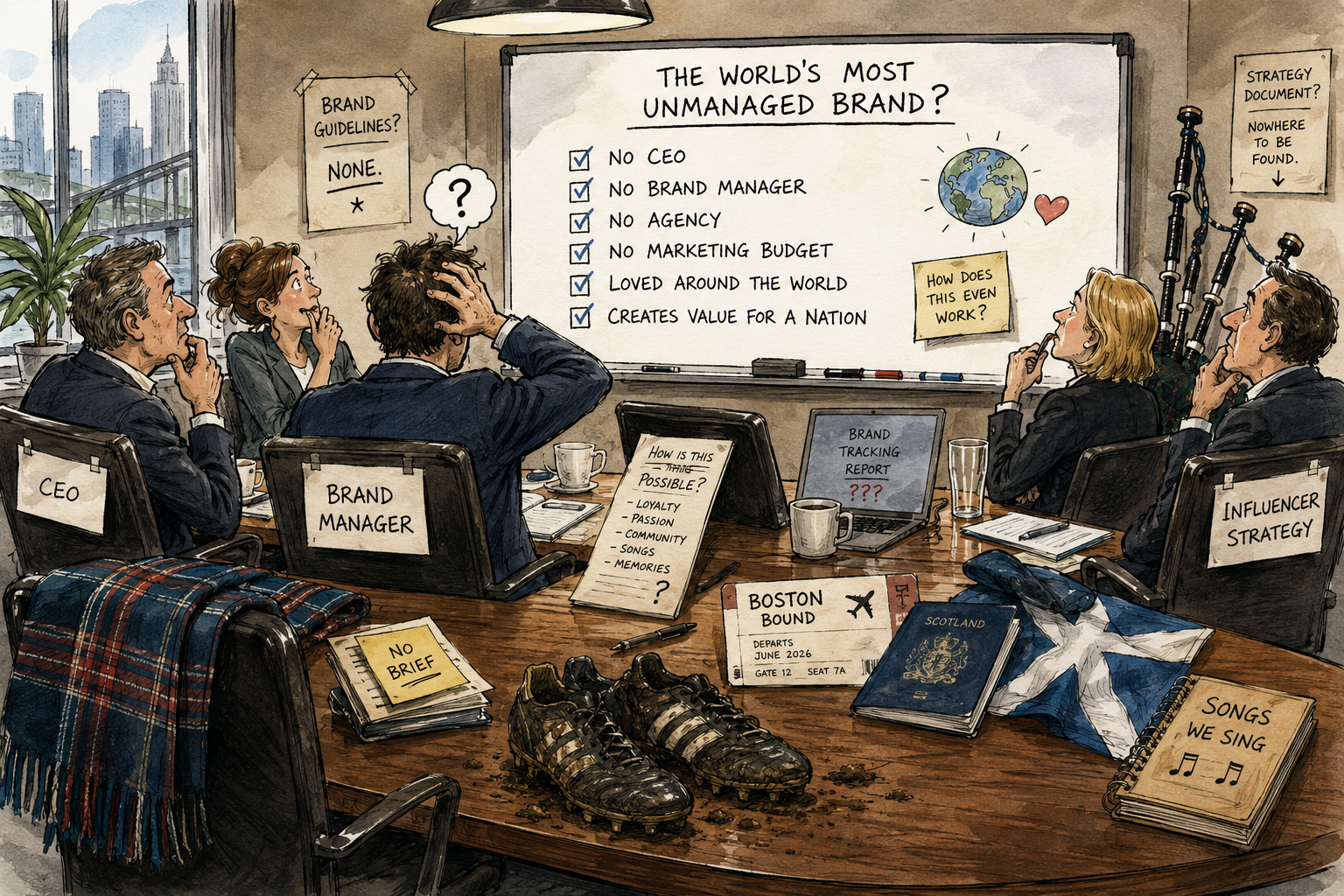
Imagine, if you will, a global brand with no Chief Executive, no marketing director, no brand agency, no annual strategy awayday, no carefully-policed visual identity guidelines, no CRM system, no paid influencer programme and — as far as I can tell — absolutely no interest in “brand purpose workshops”.
And yet this brand is instantly recognisable, emotionally powerful, internationally admired and capable of generating extraordinary value for the country it represents.
It has a uniform, but no dress code. It has a soundtrack, but no real composer. It has ambassadors, but no appointments process. It can take over a city without invading it and without losing goodwill, and turn events into a piece of travelling national theatre.
So, with some pride and only the slightest hint of personal bias, my latest Brand Icon Award goes to the Tartan Army.
The World Cup coverage from Boston has been joyous and reminded us of something Scotland should perhaps value rather more consciously. Yes, the headlines inevitably leaned into the familiar tropes: kilts, pipes, pints, songs and a city discovering that its beer supply chain had not been stress-tested against tens of thousands of Scots in tournament mode.
But beneath the easy humour lies something much more interesting from a brand perspective.
The Tartan Army is not just a group of football supporters. It is one of Scotland’s most effective soft-power assets. It carries the Saltire into the world in a way that is noisy, imperfect, funny, emotional and profoundly human. It does what national tourist boards, government campaigns and trade missions can only dream of doing: it creates affection.
In Boston, that affection seemed to flow both ways. Thousands of Scottish fans marched to Fenway Park with bagpipes playing, kilts swinging and voices in full working order – and that was for a baseball game! Local media covered them not as a threat, but as a phenomenon. There was bemusement, certainly, but also warmth. The Scots had arrived, and Boston — a city with its own powerful sense of identity, history and immigrant memory — appeared to understand the performance.
And performance is the right word. Great brands are not merely seen; they are experienced. My last brand Icon, Montblanc, has its white star, its crafted pen, its sense of literate permanence. The Tartan Army has tartan, song, humour, loyalty and collective self-deprecation. One is luxury goods. The other is mass emotional participation. But both understand the power of symbol and ritual.
The genius of the Tartan Army is that nobody invented it in a boardroom. It grew organically out of loyalty, disappointment, resilience and hope — that very Scottish cocktail of expecting disaster while booking the flight anyway.
For many fans, Scotland’s return to the World Cup after 28 years was not just a sporting event. It was a generational release. Some had waited since childhood. Some had never seen Scotland at a World Cup at all. Others travelled enormous distances and spent eye-watering sums because, as one fan put it, this might genuinely be a once-in-a-lifetime opportunity.
That matters because strong brands are built on emotional truth. The Tartan Army is not pretending to care. It cares too much. It cares through decades of near misses, gallant failures, qualifying heartbreaks and occasional glorious moments that keep the whole enterprise alive.
There is also a deeper point here about national identity. Scotland can sometimes appear unsure how to present itself to the world: modern or traditional, serious or playful, European or Atlantic, progressive or nostalgic. The Tartan Army somehow bundles all of that into one gloriously untidy travelling identity. It is old Scotland and new Scotland. It is Burns, Braveheart, airport pints, social media clips, dry Scottish wit, diaspora longing and the emotional geography of Hampden Park.
Is it always elegant? No. Is it always sober? Pretty much never. But brand icons rarely emerge from perfect behaviour. They emerge from consistency, distinctiveness and emotional resonance.
The Tartan Army’s great achievement is that it turns support into reputation. It makes people smile at Scotland before they have bought a bottle of whisky, booked a Highland holiday, read a Burns poem or understood what is worn under a kilt.
That is brand value of the rarest kind.
So this Brand Icon Award is not for a logo, a product or a corporation. It is for a living, singing, hoarse expression of national character.
No CEO. No brand manager. No agency.
No Scotland, no party.

Leave a Reply