
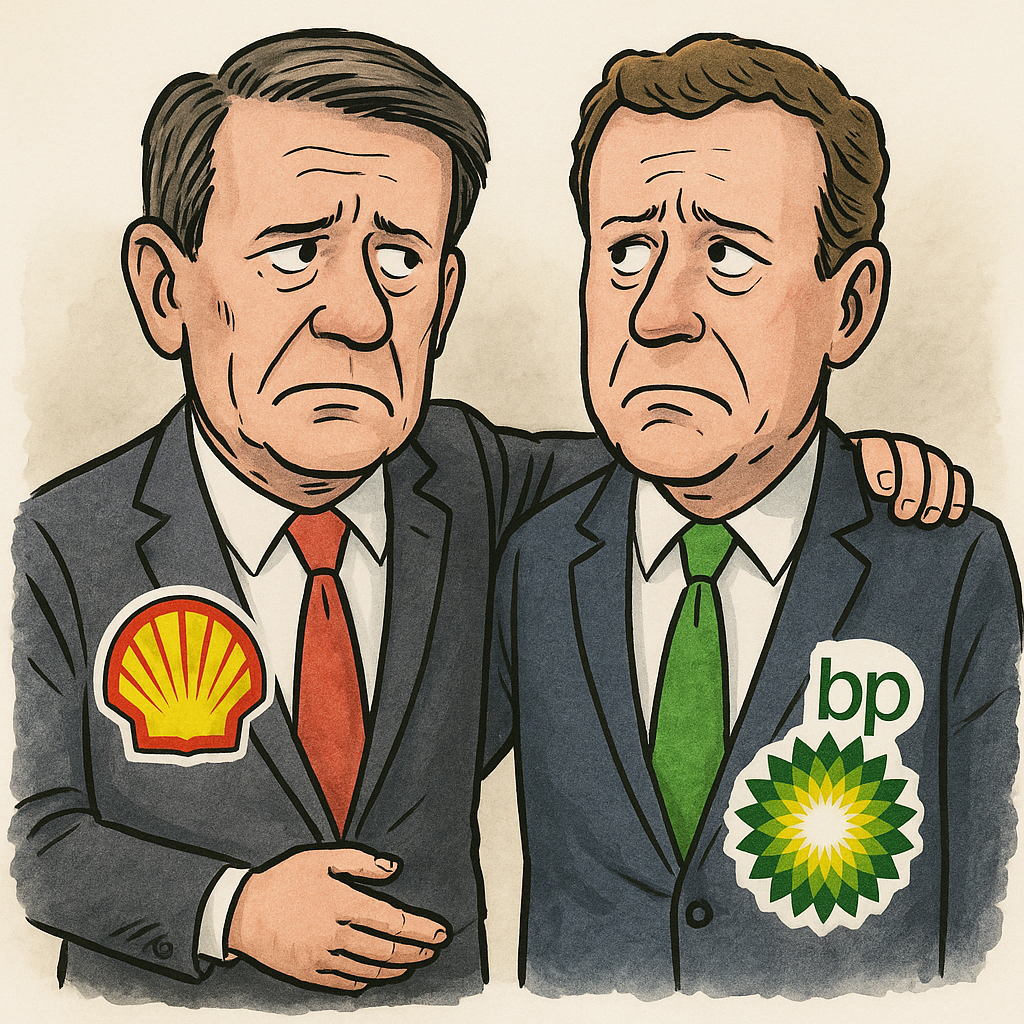
I couldn’t resist returning to my old stomping grounds for this post — the perennial rumour that refuses to die: a Shell/BP merger. It surfaces every few years, and of course, nothing ever happens — but that’s not to say it never will.
It’s true that it’s been eight years since I last walked the hallowed corridors of BP’s St. James’s Square HQ, and a slightly scary 27 years since my Shell days. But these companies are both over a century old for a reason: business success and strong, deeply embedded cultures.
It’s also been over 25 years since the mega-merger wave that brought BP and Amoco, Exxon and Mobil, Chevron and Texaco together, followed by several others. Shell, notably, arrived late to the party, with its BG Group acquisition not happening until 2015.
So, the first question: would a Shell-BP link-up actually create value?
BP’s own value base and share price have consistently lagged behind peers for many years. Frankly, since I joined BP (was I the jinx?), major shareholders have been open in their frustration that the company seems determined to destroy value at every turn. Within weeks of me joining, the Texas City disaster hit, followed by an Alaska oil spill and then Lord Browne’s undignified departure. Then, of course, the Deepwater Horizon disaster blew another massive hole in the share price. Having (just) survived and carefully rebuilt its reputation, BP saw the recent departure of yet another CEO for non-business reasons, followed by strategic flip-flopping between a “green energy” pivot and subsequent return to oil and gas. As a result, over the past five years, BP’s shares have risen by just 9%, while Shell is up 64% and ExxonMobil has surged by 168%. It’s been perfectly clear to everyone that something has gone badly wrong (again).
But just because BP is potentially a cheap buy, would Shell gain significant value from an acquisition?
I’ll stick my neck out here and say that Shell will not make a move (probably not much of a risk, given that this has been the case time after time when these rumours have surfaced!).
The reasons, to me, are threefold:
1. The Strategic Case is not Compelling Enough
While a Shell-BP combination looks powerful on paper — global scale, cost synergies, a stronger competitive position vs. ExxonMobil — the real-world value add is far less clear:
- Shell is already a larger and more profitable entity, with higher ROCE and better market performance in recent years.
- BP’s underperformance is largely self-inflicted (strategy missteps, leadership instability). It’s not obvious that Shell could extract much additional value beyond the oft-cited $4–5 billion/year in synergies.
- Integration would absorb senior management bandwidth for at least 12–24 months, diverting focus from Shell’s own energy transition, LNG expansion, and capital discipline — all areas where Shell is currently winning investor confidence.
In short, Shell doesn’t need BP to succeed; the incremental strategic gain may not justify the enormous effort and distraction.
2. The Regulatory and Political Barriers Are Exceptionally High
A merger would trigger intense scrutiny from:
- The UK Competition and Markets Authority (CMA), which would demand major divestments in retail fuel, refining and potentially North Sea assets to preserve competition.
- EU, U.S., and global antitrust regulators, given Shell and BP’s overlapping international portfolios.
- Environmental and consumer advocates, who would likely oppose creating an even larger fossil fuel giant.
- UK government and public stakeholders, who could see the disappearance of BP as an independent British corporate champion as a national blow.
The likelihood of protracted, politically sensitive, and costly regulatory battles is very high. Even if the merger were eventually cleared, the required asset sales could erode much of the deal’s economic logic.
3. Shareholder Preference Currently Favours Organic Growth and Buybacks
Shell’s shareholders — especially long-term institutional holders — are currently backing the company’s focus on:
- Delivering strong cash flows from existing assets.
- Returning capital via dividends and share buybacks (the current $3.5 billion programme).
- Selectively investing in profitable energy transition opportunities, LNG, and upstream assets.
A major M&A move, particularly one with such reputational baggage, could spook investors, raise concerns about capital discipline, and depress Shell’s share price in the short to medium term. Unless shareholders see overwhelming value (which today’s numbers don’t yet show), pursuing BP could backfire with the investor base.
Of course, there are always provisos. If BP’s problems persist, its share price declines further, or a state player or U.S. major starts sniffing around, Shell’s position might be forced — particularly if BP and the UK government start looking for a white knight (in this case, a red-and-yellow one).
Stay tuned!
Leave a Reply